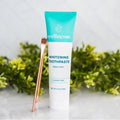



Hydroxyapatite is an important mineral in the human body. It makes up most of our tooth enamel and plays a major role in bone structure. Because it’s already such a natural part of us, scientists and dental professionals have been interested for years in how hydroxyapatite can support oral health.
In recent decades, nano-hydroxyapatite (often called nHA) has become a popular ingredient in toothpaste, especially as an alternative to fluoride. Many oral care brands like it because it closely mimics the structure of tooth enamel.
At the same time, more dentists and consumers are starting to look more closely at how nano-hydroxyapatite is made and how it behaves in the body. Since it’s engineered in a lab to reach an extremely small particle size, questions about nano-sized materials and long-term exposure have led some brands to explore non-nano forms of hydroxyapatite instead.
This change is part of a bigger shift toward using ingredients that stay closer to their natural form while still doing a great job supporting and protecting enamel.
What Is Nano-Hydroxyapatite?
Nano-hydroxyapatite is a lab-made version of the mineral hydroxyapatite that naturally makes up our teeth and bones. It’s broken down into extremely tiny particles so it can stick to tooth enamel and help repair early damage. Since enamel is mostly hydroxyapatite to begin with, the idea is that nano-HA works by mimicking what your teeth are already made of.
That said, nano-hydroxyapatite hasn’t come without questions. Some dentists, scientists, and consumers have raised concerns about how these ultra-small particles interact with the body and how their long-term safety is evaluated. The same tiny size that makes nano-HA effective is also what’s driving closer scrutiny around how it behaves once it’s in the mouth and beyond.
Primary Concerns About Nano-Hydroxyapatite
1. Nanoparticles and how they interact with the body
Nanoparticles don’t behave the same way larger particles do. Because they’re so small and have a much higher surface area, there are questions around whether they can move and be absorbed in areas outside of where they’re applied.
Common concerns include whether nano-sized materials can be absorbed into cells or tissues, travel to other parts of the body, or cross natural protective barriers. Early safety discussions around nano-hydroxyapatite raised theoretical concerns about particles entering the bloodstream or interacting with DNA, even if those risks weren’t fully proven.
2. Particle shape matters more than you might think
It’s not just the size of nanoparticles that matters, but their shape too. Certain rod-shaped particles, within specific size ranges, are considered acceptable for oral care use. Other shapes, like needle-like particles, haven’t been cleared as safe because early research suggested they may be more biologically reactive.
This becomes important because many products don’t clearly explain the shape or surface treatment of the nano-hydroxyapatite they use.
3. The bigger question: what exactly are we using every day?
One of the main concerns with nano-hydroxyapatite isn’t just what it does, but what it is. In its engineered nano form, it doesn’t exist in nature. It’s created in a lab using synthetic processes to shrink the mineral down to an ultra-small size. Still, many people use products containing nano-hydroxyapatite twice a day, every day, without thinking much about long-term exposure.
In other areas of wellness, people often question synthetic ingredients in food, skincare, and supplements, but toothpaste tends to get a free pass. That raises a fair question: why are we so comfortable using a lab-created, non-natural material daily in our mouths, one of the most absorbent and biologically active areas of the body, without giving it a second thought?
Leaning Into a Non-Nano Hydroxyapatite Toothpaste
A much cleaner, natural approach is the use of natural micro-hydroxyapatite (mHA). This refers to hydroxyapatite particles that are significantly larger than nanoparticles, derived from natural mineral sources, and sized in the micrometer range rather than the nanometer range.
These particles behave more like traditional minerals or remineralizing agents that stay on the surface of the enamel. They do not penetrate deeply into microscopic fissures of enamel the way nano particles do, but they strongly adhere to the surface, helping to strengthen and protect enamel.
Why Natural Micro-Hydroxyapatite May Be Better Quality
There are several reasons why micro-hydroxyapatite might be viewed as a higher quality or safer choice for many users:
Biocompatibility and Safety
Micro-HA is essentially the same mineral that naturally makes up tooth enamel. Its larger particles act at the surface level and are not designed to enter cells or tissues. This removes a key concern that arises with nanoparticles.
Surface Remineralization
Micro-HA successfully deposits on enamel and forms a protective layer that makes the tooth more resistant to acid attack. While it may not penetrate deep, its surface action supports enamel maintenance and can help reduce sensitivity and protect against cavity formation.
Natural Origin and Extraction
Micro-hydroxyapatite products are sourced from naturally occurring mineral deposits rather than being engineered. For consumers who prioritize more natural and minimally processed ingredients in oral care products, micro-HA aligns well with those preferences.
Next Steps
At the end of the day, the conversation around nano-hydroxyapatite comes down to choice and awareness. Nano-hydroxyapatite is not a naturally occurring material in its engineered form, and its ultra-small particle size introduces questions that science is still working to fully answer.
For many people, that uncertainty alone is enough to pause and look for alternatives. Non-nano hydroxyapatite offers a compelling option. It stays closer to the mineral form found in nature, avoids the complexities of nanoparticle behavior, and still supports enamel strength and remineralization. For those who prefer ingredients that align more closely with the body’s biology, non-nano hydroxyapatite can be a better-suited, more intuitive choice for everyday oral care.
If you are considering switching your toothpaste or oral care products, a discussion with a dental professional can help you choose an approach that matches your health goals and comfort with emerging materials science.


